

Is a Custom Sheitel Worth the Investment? 2026 Review
Table of Contents
- Cost Per Wear: The Math Behind a Custom Sheitel
- Ready-to-Wear vs Custom Sheitels: What $1,500 to $8,000 Buys
- Human Hair Wig Lifespan: How Long Should a Sheitel Last?
- Best Human Hair for Hair Loss: Matching Density and Base Type
- Maintaining Luxury Sheitels: Care Costs and Repair Options
- The Hidden Value: Resale Potential and Lifestyle ROI
- Conclusion: Is a Custom Sheitel Worth the Investment?
- Frequently Asked Questions
Last Updated: September 15, 2026
Cost Per Wear: The Math Behind a Custom Sheitel
Is a custom sheitel worth the investment? For daily wearers, the answer usually comes down to math, not emotion. The global hair wigs and extensions market reached an estimated $16.4 billion in 2026, and custom pieces sit at the top of that market for one reason: they are engineered to be worn constantly, not occasionally.
A 2026 cost-per-wear analysis from Millionaire Beauty Brand Extensions' custom sheitel comparison found that a $5,000 custom sheitel worn daily for three years works out to roughly $4.50 per day. That is less than most people spend on coffee.
What Daily Wearers Actually Pay
The per-day figure only holds up when the piece lasts. A hand-made customized sheitel purchased for about $1,000 was reportedly worn for 10 years by one long-term owner, according to a Reddit discussion on sheitel durability. Longevity, not sticker price, is what drives real value.
Ready-to-Wear vs Custom Sheitels: What $1,500 to $8,000 Buys
Ready-to-wear wigs and custom sheitels differ mainly in construction, fit, and how the hair is processed. Off-the-shelf, machine-wefted human hair options sell at lower price points, while custom-made sheitels retail significantly higher, according to Emma Tarlo's research on sheitel economics. Custom luxury sheitels typically range from $3,500 to $8,000 or more, per Lev Wigs' pricing tier analysis.
| Option | Typical Price | Construction | Best For |
|---|---|---|---|
| Ready-to-wear | $300-$1,500 | Machine-wefted, standard cap | Occasional wear, first-time buyers |
| Mid-tier custom | $1,500-$3,500 | Hand-tied sections, semi-custom fit | Regular but not daily wear |
| Luxury custom | $3,500-$8,000+ | Full hand-tied, virgin hair, custom cap | Daily wear, modesty observance |
Construction Standards That Drive the Price
Cap construction is where most of the money goes. A hand-tied, monofilament cap with a lace front and a realistic parietal section mimics natural scalp growth and allows parting in any direction. Virgin, cuticle-aligned hair holds its texture longer than processed hair, which is why it commands a higher price point.
The mechanism matters more than the label. In a machine-wefted cap, hair is sewn in rows onto a strip, which creates bulk and limits parting. In a hand-tied cap, each strand is knotted individually into a fine mesh or mono base, so the hair moves independently and the scalp illusion holds up under close inspection. A lace front adds a sheer edge that disappears against skin; a silk top conceals knots entirely for the most realistic part. These are the features that separate a $1,500 piece from a $6,000 piece, not the brand name on the box.
Objective Quality Indicators for Non-Experts
Most buyers cannot tell virgin hair from processed hair by touch alone, and marketing language is deliberately vague. Use this checklist before you commit:
- Cuticle direction. Run your fingers from root to tip, then tip to root. Virgin, cuticle-aligned hair feels smooth in one direction and slightly rough in the other. If it feels identical both ways, the cuticle has been stripped.
- Shedding test. Comb a small section firmly over a white cloth. A few strands is normal; a clump means weak knots or poor ventilation.
- Knot visibility. Part the hair at the crown under bright light. Hand-tied knots should be small and evenly spaced. Large or clustered knots signal rushed construction.
- Base breathability. Press the cap against your forearm. A mono or mesh base lets heat and moisture pass through; a solid, coated base will feel clammy within seconds.
- Return policy. A maker confident in construction will offer a short inspection window. Ask what happens if the cap does not fit or the color reads wrong in daylight.
Where the Money Actually Goes
A useful rule of thumb: roughly half the cost of a luxury custom sheitel is the raw hair itself, and the rest is labor, cap materials, and the fitting process. That is why two pieces at the same price can perform very differently, one may use longer, cuticle-aligned strands with a hand-tied cap, while the other uses shorter, processed hair on a partially machine-made base. Asking the maker directly which of those two you are buying is the fastest way to know whether the price is justified.

Human Hair Wig Lifespan: How Long Should a Sheitel Last?
A well-maintained human hair wig lasts three or more years with daily wear. Cheaper pieces often need replacing within 12 to 18 months, which erases the upfront savings.
Several factors determine human hair wig lifespan: hair origin and quality, cap construction, how often the piece is worn, and how faithfully you follow a maintenance schedule. Density also matters. Higher-density pieces (180% and above) tend to show wear at the part line sooner because more weight pulls on the base.
Best Human Hair for Hair Loss: Matching Density and Base Type
The best human hair for hair loss is virgin, cuticle-aligned human hair set into a breathable base that matches your natural density. For thinning at the crown or part, a topper often outperforms a full wig.

Mono base toppers use a fine monofilament base where each strand is hand-tied, allowing multi-directional parting. Silk base toppers layer silk to conceal knots for the most realistic scalp illusion. Mesh base toppers prioritize breathability for sensitive scalps.
Matching density to your natural hair prevents the "piecey" look. Light density (110%-120%) suits fine hair; medium (130%-140%) suits medium-length natural hair; high density (160%-180%) matches thick hair. Millionaire Beauty Brand Extensions offers mono, silk, and mesh base toppers starting at $700, plus the Cassandra collection at $912.50, all in 100% human hair.
Maintaining Luxury Sheitels: Care Costs and Repair Options
Maintaining luxury sheitels costs far less than replacing them, but the routine is non-negotiable. Budget for sulfate-free shampoo, conditioner, a wide-tooth comb, a wig stand, and a travel case. A $50-$80 travel case is a small line item that protects a four-figure purchase, per Lev Wigs' care guidance.
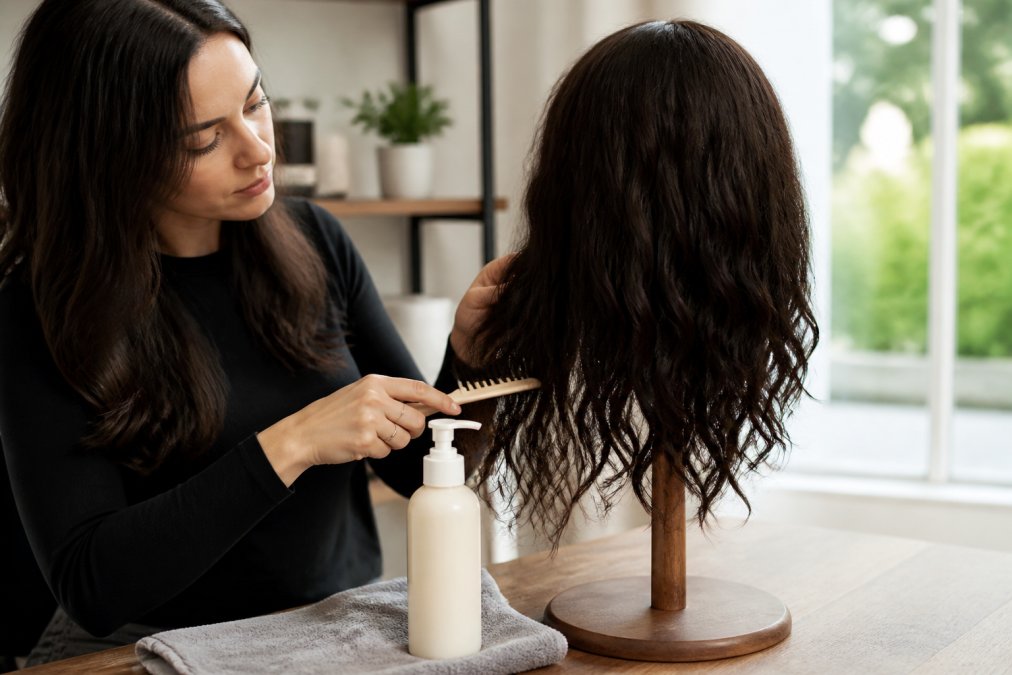
A practical weekly routine:
- Detangle gently from ends upward before washing
- Wash with sulfate-free shampoo in cool water
- Condition mid-length to ends only
- Air dry on a wig stand, never a heated surface
- Apply heat protectant before any styling tool
- Store on the stand or in a travel case between wears
What Maintenance Actually Costs Per Year
Consumables are the smallest line item.
Professional Repair and Refurbishment Costs
When Repair Stops Making Sense
The Hidden Value: Resale Potential and Lifestyle ROI
Conclusion: Is a Custom Sheitel Worth the Investment?
Frequently Asked Questions
How much should a custom sheitel cost in 2026?
Custom luxury sheitels typically range from $3,500 to $8,000 or more, depending on hair length, density, and construction. At Millionaire Beauty Brand Extensions, sheitels start at $1,500. The price reflects 100% premium human hair, hand-crafted ventilation, and a 10cm x 10cm hand-crafted parietal section that mimics natural scalp growth. Budget-friendly options exist, but they often lack the cuticle alignment and durability that daily wear demands.
How long does a high-quality sheitel last with daily wear?
A well-maintained custom sheitel lasts 3+ years with daily wear. One documented case saw a hand-made customized sheitel worn for 10 years, though that is exceptional. The human hair wig lifespan depends on hair origin, cuticle alignment, and your maintenance schedule. Proper care, including sulfate-free washing, gentle detangling, and storing on a wig stand, preserves softness and integrity. Without that upkeep, even premium pieces can degrade within 18 months.
Are there hidden costs to maintaining a luxury human hair wig?
Yes. Beyond the purchase price, budget for professional wig care every 6 to 8 weeks, which can run $100 to $300 per session. A travel case costs $50 to $80. Professional repair and refurbishment for shedding or tangling may add $150 to $500 annually. These costs are part of maintaining luxury sheitels, but they extend the piece's life and protect your investment. Factor them into your cost-per-wear calculation before buying.
What makes a custom sheitel more natural-looking than a stock wig?
Custom sheitels use hand-tied construction, a hand-crafted parietal section, and cuticle-aligned virgin hair to create a seamless, undetectable finish. Stock wigs often use processed hair and machine-wefted caps that look bulky at the part. A custom piece is built to your head measurements, hair texture, and density preference, so it moves and parts like natural hair. That customization is why a $5,000 sheitel can look more believable than a $500 stock wig.
How do I determine if a custom sheitel fits my budget and needs?
Calculate cost-per-wear first. A $5,000 sheitel worn daily for three years costs about $4.50 per day. If you wear a sheitel daily for religious or professional reasons, that math often justifies the investment. If you wear one occasionally, a ready-to-wear piece or a $700 to $912.50 topper from Millionaire Beauty Brand Extensions may serve you better. Also weigh your need for specific color matching, breathability, and styling versatility before committing.