

Maintain Luxury Hair Extensions: 2026 Guide
Table of Contents
- Understanding Luxury Extension Care in 2026
- How to Prevent Hair Extension Tangling
- Hair Extension Maintenance Schedule for Longevity
- Best Sulfate-Free Shampoo for Extensions
- Heat Styling Best Practices and Bond Protection
- Troubleshooting Common Extension Issues
- Maintaining Your Luxury Extensions Long-Term
- Frequently Asked Questions
Last Updated: September 4, 2026
The global hair extension market is projected to reach USD 8.6 billion in 2026 and grow to USD 15.4 billion by 2033, according to Persistence Market Research. As investment in premium hair rises, so does the gap between buying luxury and actually keeping it luxurious. Maintaining luxury human hair extensions in 2026 is less about expensive products and more about understanding the specific care your investment demands. Below, we'll show you exactly how to protect that investment with a maintenance routine built for longevity.
Understanding Luxury Extension Care in 2026
Luxury extension care is the disciplined practice of protecting both the added hair and the natural strands beneath it through targeted washing, brushing, and thermal habits. The 2026 market has shifted decisively toward dimensional color and seamless blends that prioritize hair vitality over dramatic length. Industry leaders confirm that "weightless lengths" paired with invisible, seamless blends now dominate professional preferences, which changes how you must care for the hair Great Lengths 2026 trend report.
The key mindset shift: maintenance is fundamentally about protecting the natural hair underneath. When you treat your scalp and natural strands as the foundation, every product choice and brushing habit follows logically.
How to Prevent Hair Extension Tangling
Extensions most commonly fail due to tangling at the mid-lengths and ends, when cuticle layers catch on each other. Prevention requires friction reduction and gentle detangling that respects attachment points.
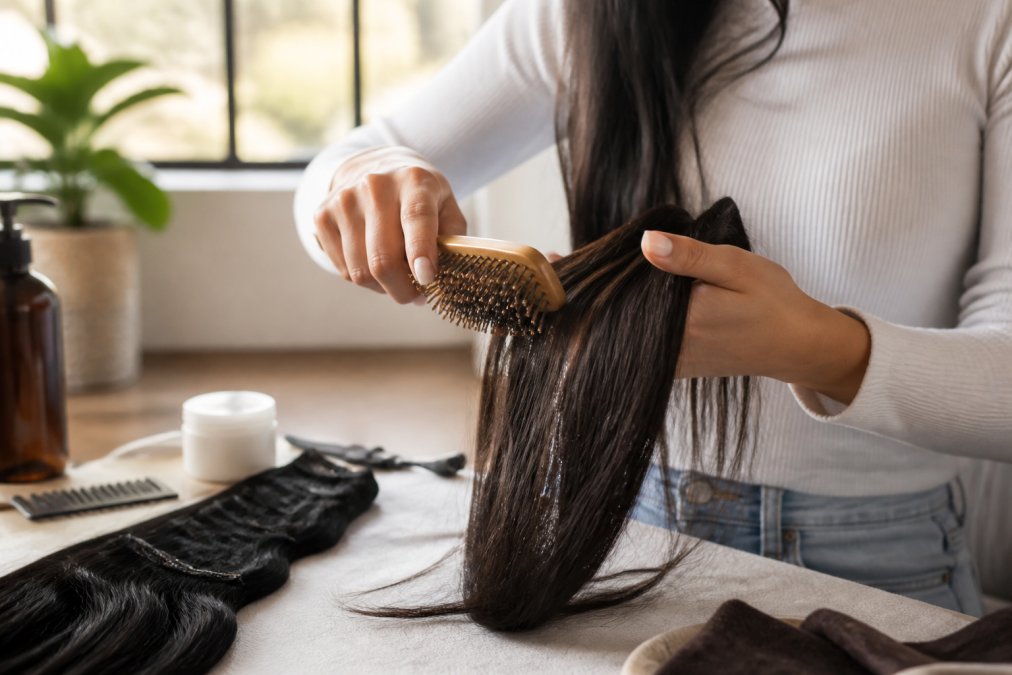
Proper Brushing Techniques for Seamless Blends
Use a dedicated detangling brush with flexible loop bristles; standard brushes snag on attachment points and accelerate shedding. Always brush from the ends upward, holding the hair above the section you're working on to reduce scalp tension.
Overnight Care and Friction Reduction
Nighttime friction damages extensions significantly. Sleeping on a silk or satin pillowcase and wearing hair in a loose braid or low ponytail prevents rubbing and often doubles the time between professional maintenance visits.
Hair Extension Maintenance Schedule for Longevity
A consistent maintenance schedule is the difference between extensions that last six months and those that look tired by week eight. Bonded or sew-in extensions typically require professional maintenance every 8-12 weeks to keep the integration invisible and the scalp healthy Therapy Hair Studio maintenance guide. Tape-ins and micro-beads fall on the shorter end of that range, while wefts and sew-ins can stretch closer to twelve.
Move-Up Appointments and Bond Integrity
Move-up appointments reposition extensions as natural hair grows, protecting bond integrity and preventing matting. Skipping these visits compromises both your natural hair and the extension investment. Track your schedule from day one.
Seasonal Adjustments and Environmental Bond Stress
Extensions need different care seasonally because environmental factors affect adhesive chemistry and hair protein structure. Adjusting proactively rather than reactively prevents damage.
Summer (May-August): High humidity and UV exposure weaken bonds and degrade keratin proteins. Chlorine and saltwater strip protective oils and weaken adhesive. Response: Clarify monthly with chelating shampoo, deep condition weekly, apply UV-protective leave-in spray, and schedule move-ups every 8 weeks.
Fall (September-October): Temperature swings stress the hair cuticle and can reveal adhesive weaknesses. Response: Increase leave-in conditioner use and introduce weekly protein treatments to strengthen hair before winter.
Winter (November-February): Low humidity and indoor heating create the harshest environment. Dry air lifts the cuticle, static increases friction, and adhesive bonds become brittle. Response: Reduce heat styling to 1-2 times per week, apply weekly deep conditioning masks, use a bedroom humidifier, switch to a satin pillowcase, and avoid very hot water.
Spring (March-April): Humidity rises but hair is depleted from winter. Rapid humidity swings create cuticle stress. Response: Use lightweight oils and leave-in conditioners, avoid heavy products, and schedule a professional deep conditioning treatment mid-spring.
| Season | Primary Stressor | Root Cause | Adjustment |
|---|---|---|---|
| Summer | Humidity swelling + UV damage + chlorine | Cuticle lift, protein degradation, adhesive weakening | Clarify monthly, deep condition weekly, UV protection |
| Fall | Humidity-to-dryness transition | Cuticle contraction reveals adhesive stress | Increase leave-in conditioner, add protein treatments |
| Winter | Low humidity + static + heating cycles | Cuticle lift, brittleness, adhesive brittleness | Reduce heat styling, weekly masks, satin pillowcase |
| Spring | Humidity swings + winter depletion | Cuticle stress, moisture loss | Lightweight oils, moisture focus, professional conditioning |
Best Sulfate-Free Shampoo for Extensions
The best sulfate-free shampoo cleanses without stripping natural oils. Sulfates lift the hair cuticle, causing dullness, tangling, and reduced lifespan. A no-paraben, no-sulfate formula protects the hair shaft while removing buildup.

Washing and Conditioning Guidelines
Wash extensions no more than twice per week in the shower with water running downward. Apply shampoo to roots and scalp, letting suds run through lengths. Conditioner goes on mid-lengths and ends only, never on bonds or tape.
Leave-In Conditioners and Scalp Health
A pH-balanced leave-in conditioner provides ongoing moisture retention and keeps the cuticle smooth between washes. Massage a lightweight serum onto roots to stimulate natural hair growth. Our Hair Growth Booster nourishes the scalp where healthy hair begins.
Heat Styling Best Practices and Bond Protection
Heat is the second leading cause of extension damage. Apply heat protection spray before styling, keep tools below 350 degrees, and never clamp a flat iron over a bond or tape tab, as heat can melt adhesive.
Work in small sections and pass the tool no more than twice per area; repeated passes create cumulative damage. Consider heatless styling methods like flexi rods or braid-outs to avoid thermal stress.
Troubleshooting Common Extension Issues
Issues can arise despite perfect care. Diagnosing the root cause early prevents wasted time and money on wrong fixes.
Diagnosing and Fixing Matting at the Nape
Matting at the nape (the back of the neck where extensions meet natural hair) is the most common complaint, but it has two distinct causes that require different solutions.
Type 1: Friction Matting occurs when loose natural hairs weave into extension wefts due to nighttime friction or rubbing. The matting is localized to one or two small sections and feels tangled but not permanently bonded.
Fix: Use a loop brush or wide-tooth comb with a slip product and work gently from the ends upward. Prevent recurrence by sleeping in a loose braid or low ponytail and using a satin pillowcase.
Type 2: Bond-Related Matting occurs when adhesive or tape fails, allowing the extension to slip and natural hair to wrap around the loose bond. This matting feels solid and resistant to brushing, with a visible gap between extension and scalp.
Fix: This requires professional removal and reapplication. Do not brush through bond-related matting. Schedule a move-up appointment immediately.
Prevention: Stick to your 8-12 week move-up schedule and address visible slippage within a week.
Addressing Loss of Shine and Cuticle Damage
Loss of shine signals cuticle damage from heat styling, harsh shampoo, or environmental stress. Dull hair has a raised cuticle that scatters light rather than reflecting it.
If dullness is concentrated at the ends: This points to heat damage or mechanical friction. Response: Trim 0.5-1 inch every 8-12 weeks, reduce heat styling, and apply weekly deep conditioning masks with protein.
If dullness is throughout the length: This indicates product buildup or harsh shampoo residue. Response: Use a clarifying shampoo once monthly, follow with lightweight conditioner on mid-lengths and ends, and switch to sulfate-free, paraben-free shampoo.

If dullness appears suddenly after summer or chlorine exposure: UV damage or chlorine oxidation has altered protein structure. Response: Use a chelating shampoo 1-2 times, followed by protein-rich deep conditioning. For prevention, wet hair with fresh water and apply leave-in conditioner before swimming.
Managing Adhesive Bond Failure and Excessive Shedding
Some shedding is normal, up to 3-5 strands per day. However, clusters of hair falling together or noticeable increases indicate a bond problem.
Gradual Bond Slippage shows up as extensions feeling looser or a visible gap forming between bond and scalp. The bond is weakening.
Cause: Product buildup at the attachment point, delayed move-up appointments, or heat exposure over the bond.
Fix: Schedule a move-up appointment within the week. Do not wait for the bond to fail completely.
Sudden Bond Failure shows up as clusters of 10+ hairs falling out or an entire extension tab coming loose. This requires professional removal.
Cause: Adhesive has completely failed, usually due to heat exposure, prolonged moisture exposure, or application defect.
Fix: Remove the extension immediately and do not attempt to reglue it. Have your stylist remove it and assess the natural hair underneath for damage.
Prevention: Never apply a flat iron over a tape tab or bonded section. Keep heat tools at least 0.5 inches away from attachment points. Avoid prolonged water exposure without protective products.
Recognizing When to Seek Professional Help
If you experience any of the following, book a professional appointment rather than attempting a DIY fix:
- Bond slippage or visible gaps between the extension and scalp
- Clusters of hair shedding (more than 5-10 strands at once)
- Matting that doesn't respond to gentle brushing within 10 minutes
- Sudden color changes (greenish tint from chlorine, unexpected fading)
- Breakage of your natural hair at the attachment point
Early intervention prevents small issues from becoming irreversible damage to both your extensions and your natural hair.
Maintaining Your Luxury Extensions Long-Term
Long-term maintenance of luxury human hair extensions requires treating them like the investment they are. Human hair extensions command roughly 54% of the global market because consumers willingly pay three to ten times more for quality and longevity than for synthetic alternatives Persistence Market Research hair extensions analysis. That premium only pays off with disciplined care.
The brands that thrive in 2026 are those embracing full customization as the benchmark for luxury, and that extends to maintenance Ergun Tercan Salon 2026 trends. Your routine should be as tailored as your color match. With 40+ shades available and professional-grade wefts and individual extensions, Millionaire Beauty Brand Extensions designs for seamless, natural-looking transformations that hold up to daily wear.
Invest in the right tools, including our specialty gold extension brush designed to detangle without snagging. Pair it with our Luxury Shampoo and Conditioner, formulated without parabens or sulfates. Remember: the goal is not just more hair, but healthier hair from root to tip.

Frequently Asked Questions
How often should I have my luxury hair extensions professionally maintained?
Bonded or sew-in extensions typically require professional maintenance every 8-12 weeks to check bond integrity, reposition the adhesive bonds, and ensure your natural hair underneath remains healthy. The exact frequency depends on your hair growth rate and the type of extensions you wear. Regular move-up appointments prevent matting and extend the lifespan of your investment significantly.
What's the best way to prevent my human hair extensions from tangling?
Use a detangling brush designed specifically for extensions, always brushing from the ends upward in small sections. Sleep on a silk pillowcase to reduce friction, and apply leave-in conditioner before bed. Avoid chlorine and saltwater, which cause tangling and matting. Brush gently before washing, never while wet, and always use sulfate-free products that maintain cuticle alignment and moisture retention.
Can I use regular shampoo on my luxury hair extensions?
No. Regular shampoos contain sulfates that strip moisture from extensions and damage adhesive bonds. Use only sulfate-free, pH-balanced products formulated for extensions. Luxury Shampoo ($22) from Millionaire Beauty Brand Extensions is specifically designed for all hair types including extensions, with no parabens or sulfates. Pair it with the Luxury Conditioner, infused with hemp seed oil for moisture retention and scalp health.
How do I maintain the seamless blend and natural finish of my extensions?
Maintain dimensional color and weightless lengths by following a consistent washing routine with sulfate-free products and conditioning treatments. Schedule regular move-up appointments every 8-12 weeks to preserve bond integrity and prevent visible gaps. Use heat protection before styling, avoid excessive tension in ponytails, and apply leave-in conditioner weekly. The quiet luxury aesthetic of 2026 requires consistent care to keep blends looking natural and polished.
Caring for luxury extensions demands consistency, the right products, and a willingness to protect the natural hair underneath. Millionaire Beauty Brand Extensions supports that effort with 100% human hair extensions, in-house formulated hair care, and personalized expert guidance to keep your look polished and your scalp thriving. Get started with Millionaire Beauty Brand Extensions and experience extensions that move, shine, and last as beautifully as the day they were installed.
This article was written using GrandRanker