

Milan Collections vs Custom Human Hair: 2026 Guide
Table of Contents
- Milan Collections vs Custom Human Hair: The Core Trade-Off
- Comparing Cap Construction and Scalp Comfort
- Luxury Sheitel Color Matching Tips for a Seamless Blend
- The Custom Human Hair Wig Fitting Process Explained
- How to Maintain Human Hair Sheitels for Maximum Longevity
- Cost-Per-Wear Analysis: Which Option Is the Better Investment?
- Conclusion: Choosing the Right Luxury Hair Solution
- Frequently Asked Questions
Last Updated: September 16, 2026
Milan Collections vs Custom Human Hair: The Core Trade-Off
The global hair wigs and extensions market is projected to grow from $16.4 billion in 2026 to $31.1 billion by 2033, according to Grand View Research's hair wigs and extensions market report, and the choice between ready-to-wear collections and bespoke units sits at the center of that spending. Milan Collections vs custom human hair is really a question about what you are buying: a known, consistent outcome delivered quickly, or a unit built to your exact measurements over weeks.
Ready-to-Wear Convenience and Predictability
A ready-to-wear unit arrives styled, color-matched, and ready to wear the day it ships. The appeal is predictability: you know the density, the cap size, and the finish before it reaches you. Consumers are increasingly choosing established collections over fully custom units for exactly this reason, according to Millionaire Beauty Brand Extensions on the shift toward predictable luxury hair.
Bespoke Fit and Long-Term Durability
Custom units are argued to provide better longevity and a more precise fit for individual scalp shapes, particularly for daily wear. The counterargument is real: a bespoke sheitel built around your measurements can outlast a ready-to-wear piece, and the fit at the hairline is measurably closer.
| Factor | Ready-to-Wear | Custom |
|---|---|---|
| Lead time | Days | Weeks |
| Typical lifespan | 1-2 years | 3+ years |
| Fit precision | Standard cap sizing | Built to your measurements |
| Color match | Pre-set shade range | Blended to your tone |
| Price | Lower upfront | Higher upfront |
Comparing Cap Construction and Scalp Comfort
Cap construction decides how a wig feels by evening, and it is the single most under-explained part of the ready-to-wear versus custom decision. Two units can use identical hair and feel completely different on the head because the base underneath them is built differently.
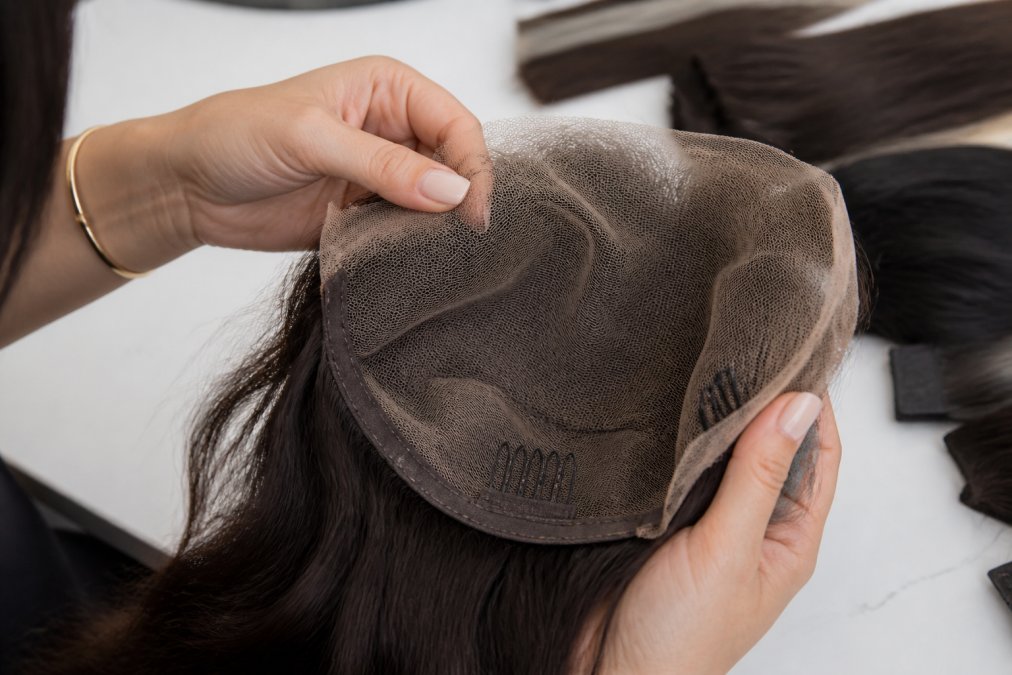
Here is how the main base types actually work:
- Monofilament (mono) top. A fine mesh where each strand is hand-tied to the base rather than sewn to a weft. Because there are no weft ridges, you can part the hair in any direction, and the mesh lets air move across the scalp. This is the base most often recommended for daily wearers and for anyone with a sensitive scalp.
- Lace front. A thin lace strip along the hairline with individually knotted hairs. It creates a natural hairline and allows styling away from the face, but lace is delicate and the knots require careful handling to avoid fraying.
- Silk top. A silk panel set behind the lace front where knots are hidden entirely, producing the most realistic parting. Silk tops are less breathable than mono mesh because the panel does not ventilate the same way, so they suit wearers who prioritize a flawless part over maximum airflow.
- Standard wefted caps. Machine-sewn wefts attached to a stretch cap. These are the most affordable and the least breathable, because densely packed wefts trap heat against the scalp.
Allergy and Scalp Sensitivity Considerations
This is the factor most comparisons skip entirely, and it matters most for people who wear a unit every day. Reactions usually come from one of three sources: adhesives and tapes used to secure the unit, dyes and processing chemicals left in the hair, or friction and pressure from the cap edge.
A few practical guardrails:
- If you react to tapes or glues, ask whether the unit can be secured with adjustable clips or a silicone grip band instead.
- Ask whether the hair has been processed with a dye or a color rinse, and whether an unprocessed or gently processed option is available.
- Choose a mono or mesh base over a densely wefted cap if you tend to overheat or itch.
- Introduce a new unit gradually, a few hours at a time, before committing to full-day wear, so you can catch a reaction early.
Why This Matters for the Ready-to-Wear vs. Custom Decision
Ready-to-wear collections standardize on a small number of base types and cap sizes, which keeps costs and lead times down but limits how precisely the base can be matched to your scalp. Custom units let you specify the base, a mono top with a lace front, a silk top with a specific parting location, a particular clip placement, which is where much of the comfort difference between the two paths actually lives.
Luxury Sheitel Color Matching Tips for a Seamless Blend
Luxury sheitel color matching tips start with one rule: match the mid-lengths of your bio hair, not the roots. Roots read darker in almost every lighting condition, and a unit matched to them will look flat and artificial. Professional colorists blend toward the mid-shaft tone, then adjust the parting area separately.
A few practical points:
- Bring a photo taken in daylight, not indoor lighting
- Note your undertone: warm, neutral, or cool
- Ask about a blended shade rather than a single flat color
- Check the match at the hairline, where contrast shows most
The Custom Human Hair Wig Fitting Process Explained
The custom human hair wig fitting process runs in four stages: measurement, cap construction, hair selection, and final fitting. Each stage adds time, and each stage is where a bespoke unit earns its price.
- Measurement. The stylist records head circumference, ear-to-ear span, nape depth, and the distance from the front hairline to the crown. These numbers determine whether the cap sits flat or rides up, and they are the reason a custom unit does not need adhesive tricks to stay in place.
- Cap construction. The base is built to those measurements, often with a hand-tied parietal section that mimics natural growth at the part. The choice of base, mono, lace, silk, or a combination, is locked in at this stage and is difficult to change later.
- Hair selection. Strands are chosen for cuticle alignment, texture, and density. Cuticle-aligned (remy) hair is arranged so all cuticles face the same direction, which reduces tangling and matting over time. Density is specified per zone, lighter at the hairline, fuller toward the crown, so the unit moves like bio hair rather than sitting as a uniform mass.
- Final fitting. The unit is trimmed, styled, and adjusted at the hairline. This is also when the stylist checks pressure points and confirms the part location matches where you actually part your hair.
Repair and Refurbishment: The Lifecycle Nobody Talks About
Most comparisons stop at the purchase. The more useful question is what happens in year two and year three, because that is where the real cost difference between ready-to-wear and custom emerges.
- Re-ventilating or re-knotting the hairline where knots have loosened or hair has thinned.
- Replacing the lace front while keeping the rest of the cap and hair intact.
- Re-taping or re-clipping the perimeter so the unit stays secure after the original fasteners wear out.
- Deep conditioning and re-texturizing the hair itself to restore softness and reduce frizz.
What to Ask Before You Commit
- How long is the production window, and is there a rush option?
- What base type is being used, and why is it the right one for your scalp?
- Is the hair cuticle-aligned, and has it been processed or dyed?
- What does a refurbishment cost, and how often is it recommended?
- Can the unit be adjusted after delivery if the fit is slightly off?
Getting clear answers to these before production starts is the difference between a unit that works for years and one that sits in a drawer.
How to Maintain Human Hair Sheitels for Maximum Longevity
How to maintain human hair sheitels comes down to four habits: sulfate-free washing, gentle detangling from the ends upward, heat protection before any styling tool, and storage on a wig stand. Skip any one of these and shedding and tangling accelerate.
- Wash every 8-12 wears, not weekly
- Condition mid-length to ends only
- Detangle with a wide-tooth comb, never a brush on wet hair
- Use heat protectant before curling or straightening
- Store on a stand, never in a bag
Cost-Per-Wear Analysis: Which Option Is the Better Investment?
Cost-per-wear is the only honest way to compare these two paths. Divide the purchase price by the number of days you will actually wear the unit.
Conclusion: Choosing the Right Luxury Hair Solution
The real decision is not which option is objectively better. It is whether you value a known outcome delivered quickly or a precise fit built over weeks, and how many days a year you will actually wear the piece.
Frequently Asked Questions
What are the primary differences between ready-to-wear Milan Collections and custom human hair wigs?
Ready-to-wear options like Milan Collections offer higher predictability and faster accessibility, with pieces typically available for immediate delivery. Custom human hair wigs provide superior personalization and long-term durability, as they are built to match your exact head shape, density preferences, and color specifications. According to Millionaire Beauty Brand Extensions, ready-to-wear pieces typically last 1 to 2 years, while custom sheitels constructed with hand-tied methods and premium human hair can last 3 or more years with proper maintenance.
How does the lifespan of a ready-to-wear wig compare to a fully custom piece?
Ready-to-wear options typically have a lifespan of 1 to 2 years, whereas custom sheitels made with hand-tied construction and premium human hair regularly last 3 or more years with proper care. The difference comes down to cap construction quality, hair cuticle alignment, and how precisely the unit fits your scalp. A custom piece distributes tension more evenly, reducing wear on individual strands and the base material.
Is a custom human hair wig worth the higher price point compared to luxury ready-to-wear?
The value depends on how often you wear the piece and how long you plan to keep it. A custom human hair wig costs more upfront but lasts 3 or more years, bringing the cost per wear down over time. Ready-to-wear options last 1 to 2 years, so replacement costs add up faster. If you wear your sheitel daily for religious or professional reasons, the long-term investment in custom typically pays off.
What are the maintenance requirements for high-end human hair wigs?
Proper care extends the life of any luxury sheitel. Use sulfate-free shampoo and condition mid-length to ends only. Detangle gently from ends upward before washing. Always apply heat protectant before styling with hot tools. Store your wig on a wig stand when not wearing it to maintain shape. Millionaire Beauty Brand Extensions recommends these steps to preserve softness and integrity, noting that proper care is the single biggest factor in whether a piece reaches its full potential.