

Luxury Sheitel Color Matching Tips: 2026 Guide
Table of Contents
- How Sheitel Color Matching Actually Works
- Best Wig Color for Skin Tone: A Shade-by-Shade Guide
- Using Color Swatches for Precise Luxury Sheitel Color Matching
- How to Blend Wig Hairline for a Seamless Finish
- Maintaining Luxury Sheitel Color Between Appointments
- Multi-Tonal Highlights and Customization Options
- Common Color Matching Mistakes to Avoid
- Conclusion
Last Updated: August 26, 2026
How Sheitel Color Matching Actually Works
Sheitel color matching is selecting a wig shade that harmonizes with your skin tone, undertone, and lifestyle so it reads as believable hair. Get it right and nobody notices the sheitel. Get it wrong and even expensive, handcrafted units look off. At Millionaire Beauty Brand Extensions, the single biggest source of disappointment isn't quality, it's color selection made without a system. The good news: there is a system, and it starts well before you look at a single shade.
Reading Your Skin Undertone Before You Shop
Skin undertone is the subtle hue beneath your surface complexion. It stays consistent regardless of tanning or seasonal changes, making it the most reliable guide for shade selection.
Three undertone categories matter for luxury sheitel color matching:
- Warm undertones: veins appear greenish, gold jewelry flatters more than silver, skin has golden, peachy, or yellow tones
- Cool undertones: veins appear bluish-purple, silver jewelry flatters, skin has pink, red, or bluish tones
- Neutral undertones: veins appear blue-green, both metals work equally, skin has balanced warm and cool tones
A practical test: hold a white piece of paper next to your bare face in daylight. If your skin looks yellowish, you're warm. If it looks pinkish or rosy, you're cool. If neither stands out, you're neutral. This undertone analysis drives every shade decision that follows.
How Lighting Conditions Change Your Color Perception
Most color matching mistakes happen because of lighting. A sheitel that looks perfect in fluorescent store light can read as brassy or flat in daylight, and vice versa.
Three lighting environments matter most:
- Natural daylight (north-facing window): the most accurate light for sheitel color matching
- Warm incandescent or LED lighting: adds a golden cast; cool ash tones can appear neutral
- Cool fluorescent lighting: strips warmth; warm chestnut shades can look flat or ashy
Always make your final color decision in natural daylight. If shopping online, photograph color swatches by a window at midday, not under kitchen lights.
Best Wig Color for Skin Tone: A Shade-by-Shade Guide
Choosing the best wig color for skin tone isn't about matching your hair exactly, it's about selecting a shade that complements your complexion so the overall effect looks cohesive and natural.
| Undertone | Recommended Shades | Shades to Approach Carefully |
|---|---|---|
| Warm | Warm chestnut, caramel highlights, golden blonde | Stark ash, cool platinum |
| Cool | Ash brown, cool espresso, natural black | Brassy orange, warm copper |
| Neutral | Balayage, ombre, soft brunettes | Very one-dimensional solid shades |
| Olive/Medium | Warm brown, dark caramel, rooted color | Flat black, stark white blonde |
Warm Undertones: Caramel, Warm Chestnut, and Golden Blondes
Warm-undertoned complexions come alive with shades that echo their natural golden base. Warm chestnut is consistently one of the most requested colors because it flatters a broad range of warm skin tones without reading as costume-y. Caramel highlights add dimension and a sun-kissed effect that keeps the look from feeling flat. For golden blondes, keep the base slightly darker with a rooted blonde and caramel mid-lengths to read as natural hair growth rather than a uniform dye job.
Cool and Neutral Undertones: Ash Tones and Natural Browns
Cool undertones call for ash-based shades: ash brown, cool espresso, and blue-based blacks. These shades neutralize pink or rosy complexions rather than amplifying them. Neutral undertones have the most flexibility, ombre and shadow root techniques work particularly well here, mimicking natural hair growth and suiting balanced complexions without pulling in either direction.
Using Color Swatches for Precise Luxury Sheitel Color Matching
Color swatches are the most reliable tool for precise sheitel color matching. A color swatch is a small section of actual human hair in a specific shade, allowing you to hold it against your skin before committing to a full unit.
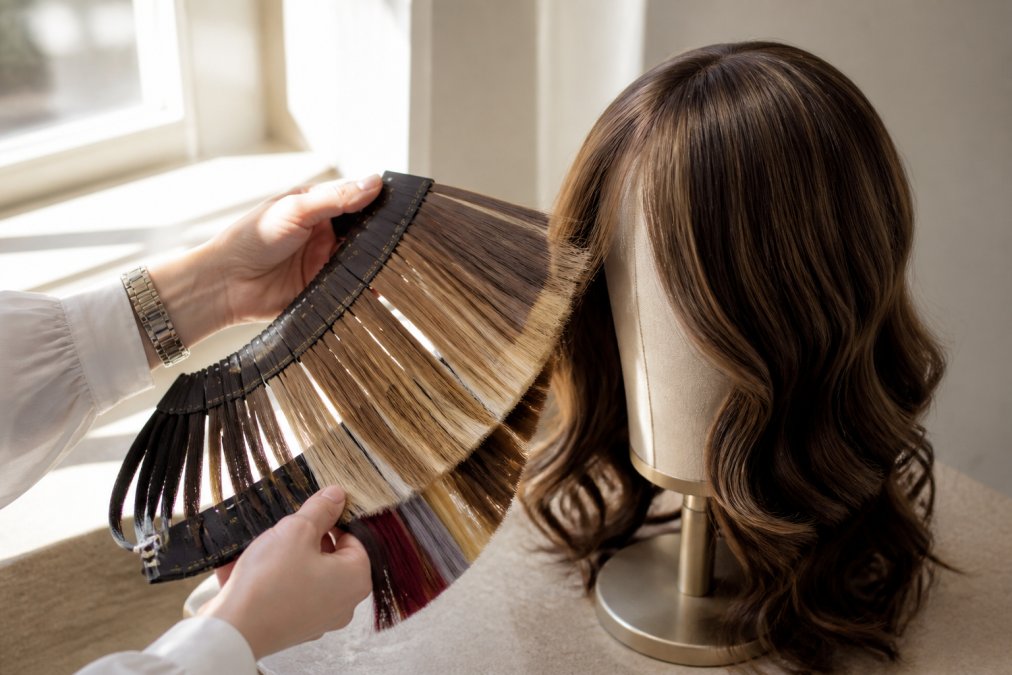
The Millionaire Beauty Brand Extensions Color Ring is a professional-grade swatch tool used by stylists and clients to accurately match and select from the full shade range before ordering. At $150, it pays for itself the first time it prevents a costly color mismatch on a $1,500 unit.

How to use a color ring effectively:
- Take the swatch to natural daylight (north-facing window, midday)
- Hold it against your jaw and cheekbone, not your hand, skin tone varies across the body
- Look for shades that disappear against your complexion rather than standing out
- Compare at least three adjacent shades before making a final selection
- Photograph the comparison for reference during your consultation
Virtual vs. In-Person Consultation Protocols
For virtual consultations:
- Use natural daylight only; no ring lights, which add a blue cast that distorts undertone reading
- Photograph your natural hair against a white background for accurate color reference
- Send at least three photos: full face in daylight, side profile, and close-up of your hairline
- Request digital color swatches mapped to your photos before finalizing
For in-person consultations:
- Bring photos of your hair in different lighting conditions
- Ask to see the sheitel on a wig stand in natural light before trying it on
- Try at least two shades side by side; the contrast helps identify which reads more naturally
- Check the hairline color specifically; it often differs from the body and is what people see first
How to Blend Wig Hairline for a Seamless Finish
Knowing how to blend wig hairline separates a sheitel that looks like a sheitel from one that looks like your actual hair. The hairline is the highest-scrutiny zone where the wig meets your skin, and any mismatch in color, density, or construction is immediately visible.
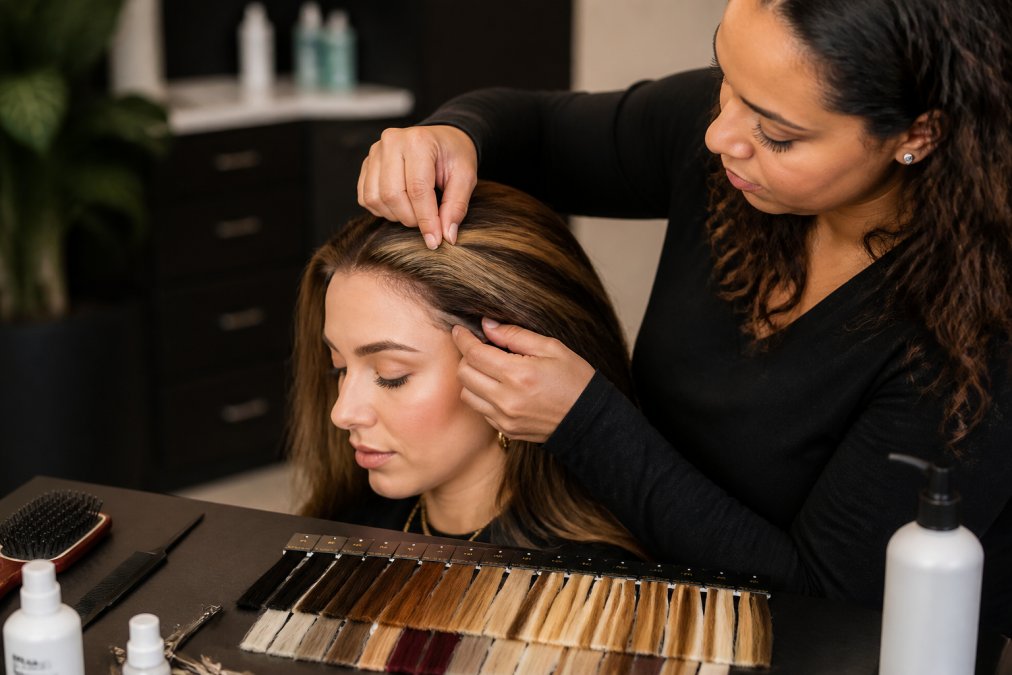
The color at the hairline should be slightly lighter than the body of the sheitel, real hair is naturally finer and less pigmented at the temples and forehead. If your sheitel has uniform color from root to tip, the hairline will look artificial regardless of shade match.
Lace Front vs. Silk Top: Which Cap Construction Blends Better
Lace front construction uses a sheer lace panel along the front hairline with hair individually hand-knotted into it. The lace lies flat against the skin and creates the illusion of a natural hairline with visible scalp between strands.
Silk top construction uses a silk layer with hair sewn beneath it, creating the appearance of hair growing directly from a scalp. The knots are hidden, producing a more realistic part and crown area. lipstick for your skin tone.
For hairline blending, lace front wins. For part and crown realism, silk top is superior. Many premium sheitels combine both: a lace front for the hairline with a silk top for the part and crown. This construction produces the most natural-looking result overall and is what you should prioritize if budget allows.
According to research published by PMC (National Institutes of Health) on Jewish women's headwear, over a third of respondents reported hair loss potentially linked to head coverings (peer-reviewed research). Cap construction choice affects scalp health and daily comfort over years of wear.
Maintaining Luxury Sheitel Color Between Appointments
Maintaining luxury sheitel color is an ongoing commitment. Human hair wigs are subject to the same environmental stressors as natural hair: UV exposure, heat styling, product buildup, and oxidation all degrade color vibrancy over time.
Weekly maintenance:
- Use sulfate-free, color-safe shampoo; sulfates strip color molecules from the hair shaft
- Condition from mid-length to ends only; avoid the roots and cap construction
- Detangle gently with a wide-tooth comb before washing
Monthly maintenance:
- Apply a deep conditioning treatment to restore moisture and seal the cuticle
- Check for brassiness or fading, particularly around the hairline and ends
- Use a UV-protective hair spray before outdoor wear
Color Fading and Oxidation Over Time
Color fading in human hair wigs follows a predictable pattern. Lighter shades, particularly highlighted sheitels and blondes, fade and oxidize faster than darker shades. Oxidation turns warm tones brassy and cool ash tones yellow-green over time.
A purple or blue toning shampoo used once every two to three weeks neutralizes brassiness in blonde and highlighted sheitels without stripping the underlying color (researchgate.net). This is the most cost-effective way to maintain color vibrancy between professional appointments.
Color Correction for Pre-Owned Units
Pre-owned sheitels present a specific color challenge: the existing color has oxidized and potentially been heat-styled hundreds of times. The hair shaft is more porous, meaning any new color deposits faster and fades faster.
Before attempting color correction on a pre-owned unit, assess the porosity by pulling a single strand taut, highly porous hair feels rough and catches on itself. Do a strand test with any toning or coloring product before applying to the full unit. Color correction on pre-owned units is best handled by a professional colorist experienced with human hair wigs.
Multi-Tonal Highlights and Customization Options
The trend toward natural-looking sheitels has driven significant demand for multi-tonal color work. A single-process, flat color reads as artificial because natural hair is never truly one shade, it has variation from root to tip, lighter pieces around the face, and depth at the nape.
Current customization options that create dimensional effect:
- Balayage: hand-painted highlights that concentrate color on the mid-lengths and ends, leaving roots naturally darker
- Ombre: a gradual fade from darker roots to lighter ends, creating depth and reducing visible regrowth
- Shadow root: a darker root application that blends into the body color, mimicking natural hair growth
- Face-framing highlights: lighter pieces concentrated around the hairline and temples, which brighten the complexion
Millionaire Beauty Brand Extensions offers custom luxury sheitels, including the Wigs 6 Color and Wigs 12 Color options, crafted from 100% premium human hair with meticulous attention to color detail and cap construction.


According to Fortune Business Insights' US Hair Extensions Market Report, the human hair extensions segment held a leading US market share of 57.32% in 2025, a clear signal that clients are prioritizing natural hair quality over synthetic alternatives, particularly at the luxury price point (fortunebusinessinsights.com).
Common Color Matching Mistakes to Avoid
Most sheitel color matching errors are preventable:
1. Matching to your hair, not your skin Your natural hair color and your most flattering sheitel color are not the same thing. Always prioritize undertone analysis over replicating your natural shade exactly.
2. Choosing color from a screen without swatches Monitor calibration varies wildly. Physical color swatches eliminate this variable entirely.
3. Ignoring the hairline color The body of the sheitel can be a perfect shade match while the hairline reads as flat or too uniform. Always check hairline density and color separately.
4. Skipping the strand test before any color treatment A five-minute strand test prevents hours of correction work.
5. Buying based on photos of someone else's coloring The shade that looks stunning on someone else may read entirely differently against your complexion.
6. Neglecting color maintenance between appointments Color vibrancy degrades steadily without active maintenance. A sulfate-free shampoo and monthly deep conditioning treatment cost a fraction of professional re-coloring.
| Common Mistake | The Fix | Impact on Result |
|---|---|---|
| Matching to hair, not skin | Prioritize undertone analysis | Eliminates clashing tones |
| Choosing color from screen only | Use physical color swatches | Removes monitor calibration error |
| Ignoring hairline color | Check hairline separately | Prevents artificial-looking front edge |
| Skipping strand test | Test before any color treatment | Prevents irreversible damage |
| No color maintenance routine | Sulfate-free shampoo + monthly conditioning | Extends color vibrancy significantly |
Getting luxury sheitel color matching right requires more than a good eye. It requires a system: undertone analysis, swatch comparison in accurate lighting, cap construction knowledge, and a maintenance routine that preserves your investment. Millionaire Beauty Brand Extensions offers 40+ shades, a professional color ring for accurate pre-purchase matching, and custom luxury sheitels crafted from 100% human hair. Start with the color ring, work through your undertone analysis, and you'll have a sheitel that looks like your hair, because to everyone else, it will be.
=== FAQ ANSWERS (audit these too, same rules) ===
[1] Q: How do I color match a luxury sheitel to my natural hair? A: Start by identifying your skin undertone, then request physical color swatches rather than relying on screen images alone. Hold swatches against your face in natural daylight, not indoor fluorescent light, which skews warm. Match to your roots first, since that is where the sheitel sits closest to your scalp. A 40-plus shade color ring, like the one offered by Millionaire Beauty Brand Extensions, gives you the precision to find shades like warm chestnut or caramel highlights that read as genuinely natural.
[2] Q: Should I choose a wig color that matches my roots or my ends? A: Match to your roots. The hairline and part area are where the sheitel meets your skin, so root color is what observers see first. If your natural hair has lighter ends from sun exposure or previous coloring, ask your stylist about a rooted or shadow-root sheitel finish. Multi-tonal highlights can replicate your natural color palette from root to tip, creating depth that a single flat shade cannot achieve. Balayage and ombre techniques in premium human hair sheitels are especially effective for this.
[3] Q: How does lighting affect luxury sheitel color selection? A: Lighting is one of the most overlooked factors in sheitel color matching. Fluorescent office light adds a greenish cast that makes warm chestnut appear muddy. Incandescent bulbs push everything amber. Natural daylight, specifically indirect outdoor light, is the most accurate environment for comparing color swatches to your skin. When shopping online, photograph your own hair in natural daylight and request that your consultant view swatches under the same conditions before finalizing your shade selection.
[4] Q: How can I make a luxury sheitel look completely natural? A: Three factors determine how natural a sheitel reads: cap construction, hairline blending, and color accuracy. A lace front or silk top cap creates a realistic scalp appearance at the part and hairline. Pressing the lace flat with a light-hold adhesive or wig tape removes the lifted edge that signals a wig. Color-wise, avoid single-process flat shades; multi-tonal highlighted sheitels with dimension and a rooted base mimic how natural hair actually grows and catches light.
Frequently Asked Questions
How do I color match a luxury sheitel to my natural hair?
Start by identifying your skin undertone, then request physical color swatches rather than relying on screen images alone. Hold swatches against your face in natural daylight, not indoor fluorescent light, which skews warm. Match to your roots first, since that is where the sheitel sits closest to your scalp. A 40-plus shade color ring, like the one offered by Millionaire Beauty Brand Extensions, gives you the precision to find shades like warm chestnut or caramel highlights that read as genuinely natural.
Should I choose a wig color that matches my roots or my ends?
Match to your roots. The hairline and part area are where the sheitel meets your skin, so root color is what observers see first. If your natural hair has lighter ends from sun exposure or previous coloring, ask your stylist about a rooted or shadow-root sheitel finish. Multi-tonal highlights can replicate your natural color palette from root to tip, creating depth that a single flat shade cannot achieve. Balayage and ombre techniques in premium human hair sheitels are especially effective for this.
How does lighting affect luxury sheitel color selection?
Lighting is one of the most overlooked factors in sheitel color matching. Fluorescent office light adds a greenish cast that makes warm chestnut appear muddy. Incandescent bulbs push everything amber. Natural daylight, specifically indirect outdoor light, is the most accurate environment for comparing color swatches to your skin. When shopping online, photograph your own hair in natural daylight and request that your consultant view swatches under the same conditions before finalizing your shade selection.
How can I make a luxury sheitel look completely natural?
Three factors determine how natural a sheitel reads: cap construction, hairline blending, and color accuracy. A lace front or silk top cap creates a realistic scalp appearance at the part and hairline. Pressing the lace flat with a light-hold adhesive or wig tape removes the lifted edge that signals a wig. Color-wise, avoid single-process flat shades; multi-tonal highlighted sheitels with dimension and a rooted base mimic how natural hair actually grows and catches light.
This article was written using GrandRanker