

Is Expensive Hair Worth the Investment? A 2026 Guide
Table of Contents
- The Real Cost of Expensive Hair: What You're Actually Paying For
- Signs of High Quality Hair Extensions: A Buyer's Checklist
- The Dilution Factor: Why Concentration Changes the Math
- Cost-Per-Use Analysis: When Premium Hair Beats Drugstore
- How to Maintain Human Hair Extensions for Longevity
- Best Professional Grade Hair Extensions 2026: What to Look For
- Common Myths About Salon-Grade Products and Designer Markups
- When to Splurge vs. When to Save on Hair Care
- Frequently Asked Questions
Last Updated: September 10, 2026
The Real Cost of Expensive Hair: What You're Actually Paying For
Is expensive hair worth the investment? The honest answer is that it depends on what you're buying and how you'll maintain it. That question sits at the center of a market where the global hair care industry is projected to reach $122.04 billion in 2026, according to Fortune Business Insights' hair care market report, while the professional segment alone is valued at $24.5 billion (Future Market Insights' professional hair care analysis).
That gap is the entire argument. The real cost of expensive hair isn't the sticker price. It's the cost per wear.
Marketing Markups vs. Manufacturing Costs
A meaningful share of what you pay for premium hair goes to packaging, advertising, and brand positioning rather than the hair itself. Critics point out that ornate boxes and heavy ad spending inflate prices without improving hair health, a case made by Louisiana First News reporting on luxury hair markups. That's real.
But it isn't the whole story. Professional-grade hair carries genuine costs that drugstore products don't: hand-selected cuticle-aligned strands, longer processing times, and quality control that removes shedding-prone wefts before they ship. The markup is real. So is the difference in raw material.
Signs of High Quality Hair Extensions: A Buyer's Checklist
The clearest sign of high-quality extensions is cuticle-aligned hair that sheds minimally, holds a curl, and returns to its original texture after washing. Everything else, from shine to softness, follows from that foundation.
Here's what to check before you buy:
- The cuticle test: Run your fingers from root to tip. Premium hair feels smooth in both directions. Roughness against the grain means cuticles are stripped or misaligned.
- The shed test: Comb a small section firmly over a white cloth. More than a few strands means weak wefts.
- The burn test: A single strand should smell like burning hair, not plastic. Plastic smell means synthetic fiber.
- The wet test: Wet a section and scrunch it. Real human hair waves and dries with texture. Synthetic hair stays limp.
- The color test: Ask whether the shade is dyed or natural.
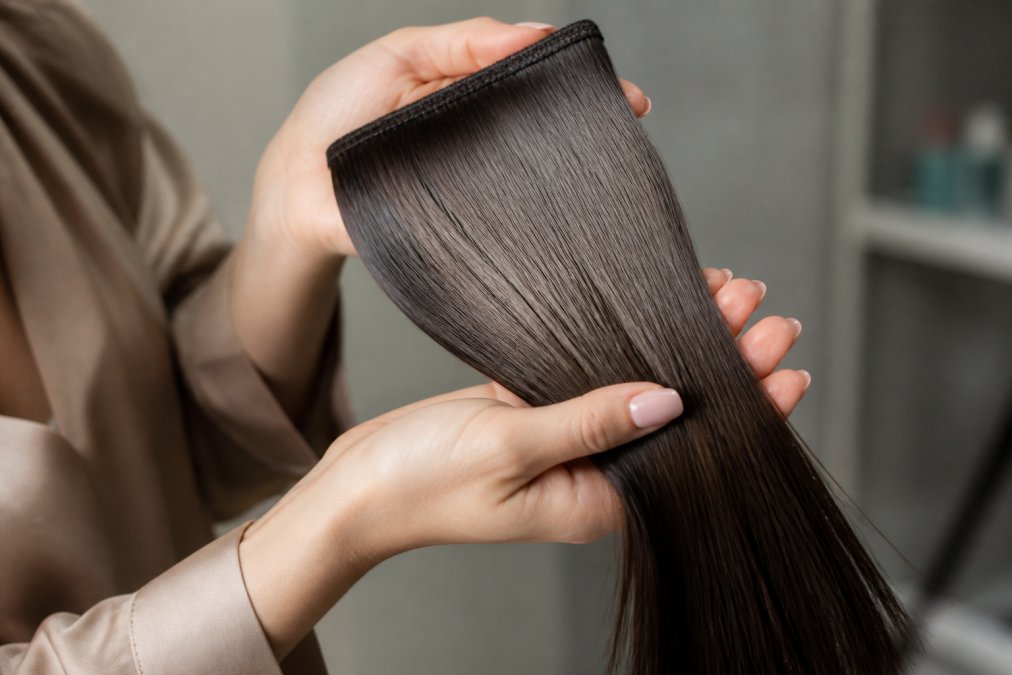
The Cuticle Test and Other At-Home Checks
The cuticle test matters most because the cuticle is the hair's outer protective layer. When it stays intact and aligned in one direction, moisture retention improves, tangling drops, and the hair survives heat styling. When it's stripped, you get the matting and shedding that make people swear off extensions entirely.
A common mistake is judging hair by shine alone. Coated hair looks glossy in the package and turns dull after two washes.
The Dilution Factor: Why Concentration Changes the Math
High-end products are often more concentrated, so a smaller amount delivers the same result. A $40 shampoo that lasts four months can cost less per wash than a $9 bottle you replace every three weeks, but only if the concentration claim is real and not just a thicker emulsifier.
The mechanism is straightforward. A shampoo is mostly water plus surfactants, conditioning agents, and preservatives. A budget formula may be 80-85% water with a modest surfactant load, which is why you need a quarter-sized squeeze to get a lather. A concentrated formula may run closer to 60-70% water with a higher active load, so a dime-sized amount cleans the same head of hair. The bottle costs more; the dose costs less.
Run the math on a per-wash basis rather than a per-bottle basis:
- Budget shampoo: $9 bottle, roughly 25 washes, about $0.36 per wash.
- Concentrated shampoo: $40 bottle, roughly 90 washes, about $0.44 per wash.
The gap narrows to pennies, and flips in favor of the premium bottle the moment you factor in fewer repurchases, less packaging waste, and the conditioning step you no longer need to buy separately.
The dilution factor cuts both ways, though. Some premium products are genuinely concentrated. Others simply use thicker emulsifiers, gums, fatty alcohols, and polymer thickeners, to feel richer without more active ingredients. Thickness is not the same as concentration. A gel-thick shampoo can be 90% water; a thin, watery one can be loaded with actives.
Here is how to tell them apart before you commit:
- Read the first five ingredients. In the U.S., ingredients are listed in descending order by weight. If water is first (it almost always is) and surfactants and conditioning agents fill positions two through five, you are paying for formulation. If water is followed by fillers, salts, and fragrance before any active appears, you are paying for texture.
- Check the dose instructions. A label that says "a dime-sized amount" is signaling concentration. A label that says "apply generously and repeat" is signaling dilution.
- Compare cost per wash, not cost per ounce. Divide the bottle price by the number of washes you actually get. That is the only number that matters.
Why This Matters for Extensions Specifically
Extension hair does not produce its own oils, so it depends entirely on what you put on it. A concentrated, low-water cleanser removes buildup without stripping the cuticle, which is the single biggest driver of how long a weft or clip-in set lasts. A diluted, high-water shampoo forces you to use more product, more often, and leaves more residue behind, residue that dulls the cuticle and shortens wear. That is the hidden cost of the cheap bottle: it does not just cost more per wash, it costs you months of extension lifespan.
Cost-Per-Use Analysis: When Premium Hair Beats Drugstore
Premium hair wins on cost per use when you wear it frequently and maintain it properly.
| Option | Upfront Cost | Lifespan | Cost Per Wear (3x/week) |
|---|---|---|---|
| High-quality human hair | $300-$512 | Up to 3 years | ~$1.00 |
| Budget alternative | ~$110 | 2-3 weeks | ~$6.00 |
| Salon cut and style | $63.71 per session | Single session | $63.71 |
The average American spends $63.71 per haircut and styling session, per Self Financial's beauty spending report, and 22.4% of consumers admit to cutting their own hair to save money. Extensions that last years change that math entirely.
How to Maintain Human Hair Extensions for Longevity
Maintaining human hair extensions comes down to three habits: gentle washing, heat protection, and preventing product buildup. Industry experts note that longevity depends more on home maintenance than on the initial purchase price, according to Love Is Pretty Hair's guidance on extension care.
Washing, Heat Styling, and Product Buildup
Wash every 8-10 wears with sulfate-free shampoo. Sulfates strip natural oils and accelerate dryness. Condition mid-length to ends only, since the scalp area doesn't need it.
Heat styling above 350°F breaks down the protein structure. Always apply thermal protection first. Product buildup from silicone-heavy serums and dry shampoo weighs hair down and dulls the cuticle, so clarify once a month.
Best Professional Grade Hair Extensions 2026: What to Look For
The best professional grade hair extensions in 2026 share four traits: 100% human hair, intact cuticles, ethical sourcing, and shade range that matches real hair. Millionaire Beauty Brand Extensions builds its collection around all four, with 40+ shades available for perfect color matching and in-house formulated hair and skin care essentials designed to extend wear.
For clip-in wearers, the Millionaire Artistry Hair Clip in Color 1 at $318 delivers 30-second transformation without commitment. Salon professionals installing wefts tend to choose the Hair Wefts Hand tied Color 60 at $512 for seamless blending. Budget-conscious buyers who still want fusion quality can start with Hot Fusion Color 10 at $151, while the Tape in extension Color 1B at $145.76 offers 20 tapes per pack for discreet volume.


Common Myths About Salon-Grade Products and Designer Markups
Salon-grade doesn't automatically mean better. Research from Associated Press reporting on shampoo effectiveness found that affordable shampoos and conditioners from grocery stores can perform as effectively as premium versions, because effectiveness depends on active ingredients rather than price point.
The myth that expensive always wins is wrong. So is the opposite claim that all luxury hair is markup. The truth sits in the formulation and the fiber. A $9 shampoo with good surfactants beats a $40 shampoo with weak ones.
When to Splurge vs. When to Save on Hair Care
The rule is not "expensive good, cheap bad." It is category-specific. Some product types earn their premium because the formulation does something a budget version physically cannot. Others are commodity items where the active ingredients are identical across price tiers. Here is the map.
Splurge Categories, Where the Premium Is Real
- Bond builders. These products use patented chemistry to rebuild disulfide bonds broken by bleach, color, and heat. The active technology is proprietary, which means there is no true budget equivalent. If you color-treat or heat-style regularly, this is the one category where the premium is not optional.
- Color-depositing and toning products. Pigment quality, color payoff, and fade resistance vary enormously by price tier. A cheap toner can leave brassy or uneven results that cost more to correct than the premium product would have cost upfront.
- Extensions, wefts, and sheitels. Cuticle integrity and ethical sourcing determine lifespan. A cuticle-aligned weft can last years; a stripped or mixed-cuticle set can mat within weeks. This is the highest-stakes splurge in the entire routine.
- Leave-in treatments for damaged or porous hair. Penetrating oils and proteins that actually absorb into the cortex cost more to formulate than surface-coating silicones. If your hair is porous, the difference is measurable.
Save Categories, Where Cheap Wins
- Basic clarifying shampoo. The job is to remove buildup. A straightforward surfactant blend does that. You do not need a luxury formula to strip residue once a month.
- Everyday conditioner for healthy hair. If your hair is not damaged, a mid-tier conditioner with good conditioning agents performs the same job as a prestige bottle. The active ingredients are largely the same class of compounds.
- Dry shampoo. The core ingredients are starch and alcohol. Price tiers change the scent and the aerosol feel, not the oil absorption.
- Tools you use twice a year. A curling iron you pull out for one event does not need to be salon-grade. Spend on the tool you use weekly; save on the one that lives in a drawer.
The Decision Framework
Ask three questions before you buy:
- Does this product do something a cheaper one physically cannot? If yes, bond builders, color deposit, extension fiber, splurge. If no, save.
- How often will I use it? Frequent use amortizes the premium. Occasional use does not.
- What is the cost of failure? A cheap conditioner that underperforms costs you a bad hair day. A cheap extension set that sheds costs you the entire purchase. Weight your spending toward the categories where failure is expensive.
Mapping the Rule to Your Hair Concern
The splurge-vs-save decision also depends on what you are trying to fix:
- Color-treated hair: Splurge on bond builders and color-safe cleansers. Save on styling tools.
- Fine or thinning hair: Splurge on lightweight, concentrated volumizing formulas. Save on heavy masks that weigh hair down.
- Frizzy or porous hair: Splurge on penetrating leave-in treatments. Save on silicone-heavy serums that mask the problem.
- Healthy, untreated hair: Save across most categories. Your hair does not need repair chemistry it does not lack.
The pattern is consistent: spend where the formulation does measurable work, save where the ingredients are commodities. Price is a signal, not a verdict.
Frequently Asked Questions
Are expensive hair products worth it?
It depends on the product category. Research from the Associated Press in 2026 found that affordable shampoos and conditioners from grocery stores can perform as effectively as premium versions because active ingredients matter more than price. However, for hair extensions, premium human hair often lasts up to 3 years versus 2-3 weeks for low-cost alternatives, according to consumer reports. The investment pays off when you factor in replacement frequency and maintenance costs.
What is the difference between professional-grade and drugstore hair extensions?
Professional-grade extensions use 100% human hair with intact cuticles, allowing for color matching, heat styling, and natural movement. Drugstore or budget alternatives often use synthetic blends or processed hair with stripped cuticles, leading to tangling and shedding. Professional-grade options like hand-tied wefts or clip-ins from Millionaire Beauty Brand Extensions offer 40+ shades and versatile styling options including washing, curling, and straightening. The key difference is longevity and how seamlessly they blend with your natural hair.
How long do high-quality human hair extensions last compared to cheap alternatives?
Premium human hair extensions can last up to 3 years with proper care, while lower-cost alternatives may need replacement every 2-3 weeks. The longevity depends more on home maintenance habits than initial purchase price. Using sulfate-free products, avoiding excessive heat, and storing extensions properly can extend their life significantly. Investing in quality hair means fewer replacements and better cost-per-use over time.
What ingredients should you look for in premium hair care?
Look for formulations that support moisture retention and scalp health without stripping natural oils. Avoid sulfates, parabens, and silicones that can cause product buildup. Instead, seek out bond builders, protein treatments, and natural oils that maintain hair integrity. For color-treated hair, pH-balanced products help preserve color and cuticle health.
The challenge with premium hair isn't the price. It's knowing which products actually justify it. Millionaire Beauty Brand Extensions offers 100% human hair extensions in 40+ shades, in-house formulated care essentials that protect your investment, and same-day shipping on orders placed before 12:00 PM PST. Get started with Millionaire Beauty Brand Extensions and build a set that lasts years, not weeks.