

How to Prevent Hair Extension Tangling: Full Guide
Table of Contents
- Why Hair Extension Tangling Happens (And What You Can Actually Fix)
- Daily Brushing Routine to Prevent Hair Extension Tangling
- Best Brush for Hair Extensions: What to Use and What to Skip
- How to Wash Hair Extensions Without Tangling
- Moisturizing, Oil Treatments, and Hydration for Long-Term Extension Longevity
- Sleeping with Hair Extensions: Habits That Stop Morning Matting
- Heat, Environment, and Styling: Protecting Extensions All Day
- Conclusion
Last Updated: August 24, 2026
Why Hair Extension Tangling Happens (And What You Can Actually Fix)
Hair extension tangling occurs when cuticles lift and catch on each other instead of lying flat. Natural hair receives continuous sebum conditioning from the scalp, but extensions do not. This causes the cuticle to dry out, lift, and create friction that leads to knots, matting, and premature breakdown. Most tangling is preventable with the right daily routine, products, and understanding of your specific extension type.
Human Hair vs. Synthetic Fibers: Why the Material Changes Everything
Human hair extensions respond to heat, moisture, and conditioning like natural hair. They can be washed, styled, and treated with professional products. When properly maintained, human hair resists tangling far better than synthetics because the cuticle can be restored with deep conditioning.
Synthetic fibers are plastic-based materials that cannot absorb moisture or conditioning agents. They tangle more readily, especially in humidity, and cannot tolerate heat or oil-based products. If you experience persistent tangling with synthetic extensions, no conditioning will solve the material limitation.
According to American Academy of Dermatology guidance on hair care, maintaining hair shaft integrity is essential for preventing breakage and tangling in both natural hair and extensions. If long-term wearability and tangle resistance are priorities, human hair extensions are a functional necessity, not a luxury upgrade.
How Your Attachment Method Affects Tangling Risk
The attachment method directly influences where tangling develops:
- Clip-in extensions have the lowest tangling risk because they are removed nightly, brushed, and stored.
- Tape-in extensions can tangle at the weft bond if roots are not brushed carefully daily.
- Sew-in wefts carry the highest risk at the braid base, as moisture gets trapped near the attachment.
- Micro-link and keratin bond extensions tangle most often at individual bond points if bonds are not sealed properly.
Knowing your attachment method lets you target prevention at the right zone.
Daily Brushing Routine to Prevent Hair Extension Tangling
Daily brushing is the single most effective tangle prevention method. It removes shed hairs before they tangle into the weft, distributes leave-in conditioner evenly, and keeps the cuticle flat. Brush morning and evening without exception.
Brushing Order and Technique That Protects the Hair Cuticle
Most people brush incorrectly, dragging tangles downward and creating more friction. The correct technique is bottom-to-top:
- Section the hair into two or three manageable sections.
- Hold the hair at mid-shaft with your non-dominant hand to prevent tension at the attachment point.
- Start brushing from the ends, working out tangles at the tips first.
- Move upward in small increments, never forcing through resistance.
- Once the ends are smooth, brush from mid-shaft to tip.
- Only when the lower half is completely smooth should you brush from root downward.
This technique protects the cuticle by never dragging a tangle through a longer section of hair and protects the attachment point from mechanical stress.
Best Brush for Hair Extensions: What to Use and What to Skip
The brush you use matters as much as technique. The wrong tool can shred the cuticle and accelerate tangling.
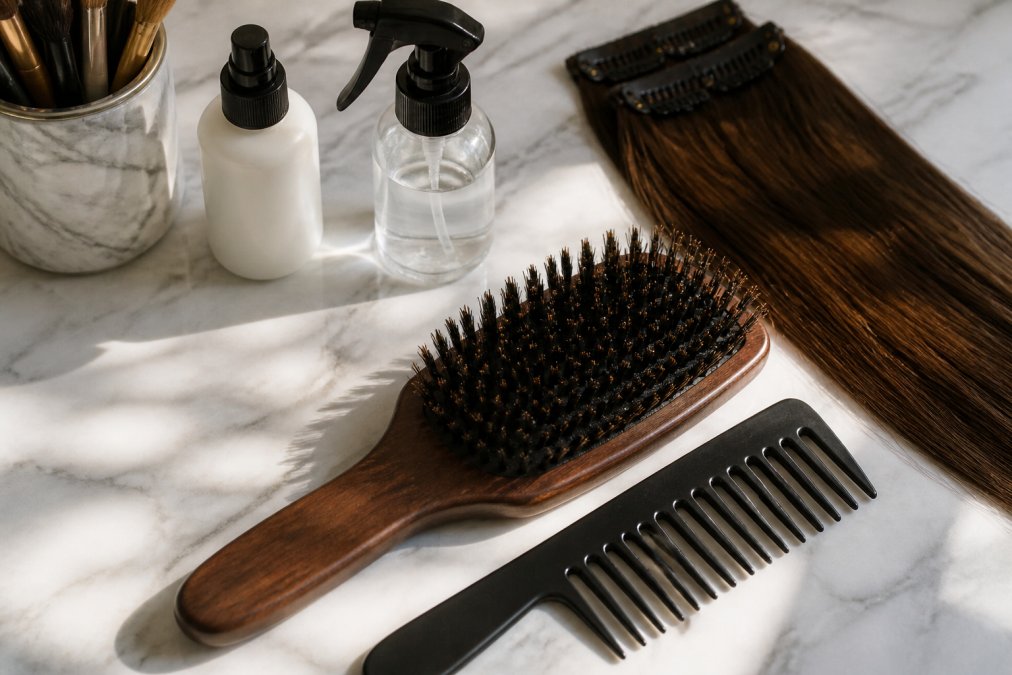
Use these:
- Boar bristle brush: The gold standard for extensions. Natural bristles smooth the cuticle, distribute oils evenly, and generate minimal static.
- Wide-tooth comb: Essential for detangling wet extensions. Never use a fine-tooth comb on wet hair.
- Loop brush (extension-specific brush): Designed with looped bristles that flex around the weft bond without catching or pulling.
Skip these:
- Fine-tooth combs: Too aggressive for extension hair and cause shedding at the weft.
- Paddle brushes with ball-tipped nylon bristles: Ball tips snag extension bonds and create friction at attachment points.
- Detangling brushes designed for thick natural hair: These apply too much tension for extension wefts.
The boar bristle brush is the single most recommended tool by professional stylists for maintaining tangle-free extensions long-term, as noted in professional hair care guidance from the Professional Beauty Association.
How to Wash Hair Extensions Without Tangling
Washing is where most tangling disasters start. The wrong technique can create knots that take hours to remove or damage the hair permanently.
Step-by-step washing technique:
- Brush the extensions thoroughly before getting them wet.
- Wet the hair with lukewarm water only. Hot water lifts the cuticle and causes immediate tangling.
- Apply shampoo to the scalp and roots only. Let suds rinse downward through the extensions.
- Rinse in a downward direction, always from root to tip. Never flip the hair upside down.
- Apply conditioner from mid-length to ends only. Avoid roots and bond points, where conditioner can loosen adhesive.
- Rinse conditioner thoroughly with lukewarm water in a downward direction.
- Gently squeeze excess water from the hair. Never wring or twist.
- Pat dry with a microfiber towel. Standard towels create friction that roughens the cuticle.
Ingredients to Avoid in Shampoos and Conditioners
Sulfates are the primary culprit. Sodium lauryl sulfate and sodium laureth sulfate strip moisture rapidly. On extensions, there is no scalp compensation. Sulfate-free shampoo is non-negotiable.
Avoid these ingredients:
- Sodium lauryl sulfate (SLS) and sodium laureth sulfate (SLES)
- Alcohol-based ingredients listed high in the formula: these dry the cuticle and increase static
- Silicone-only conditioners without penetrating agents: they coat without moisturizing, creating buildup
- Mineral oil in leave-in products: it blocks moisture absorption without hydrating
Look for these instead:
- Hydrolyzed keratin or silk proteins that strengthen the cuticle
- Glycerin and aloe vera for moisture retention
- Argan oil, jojoba oil, or coconut oil as conditioning agents
According to cosmetic ingredient safety guidance from the FDA, ingredient transparency on hair care labels is regulated, so you can trust the ingredient list to reflect what is actually in the formula.
Moisturizing, Oil Treatments, and Hydration for Long-Term Extension Longevity
Dryness is the direct precursor to tangling. A dry strand has a roughened, lifted cuticle that catches on neighboring strands constantly. Consistent hydration keeps extensions smooth and tangle-free for months longer.
The hydration routine has three layers: daily leave-in conditioning, weekly oil treatments, and periodic deep conditioning.
Daily leave-in conditioner should be applied to mid-lengths and ends every morning before brushing. Use a lightweight formula that does not weigh down the hair or leave residue at the weft.
Weekly oil treatments penetrate the hair shaft and restore suppleness. Argan oil and jojoba oil are particularly effective because their molecular structure allows penetration into the cortex rather than simply coating the surface. Apply to ends and mid-lengths, leave for 20 to 30 minutes, then wash out with sulfate-free shampoo.
Deep conditioning every two to three weeks adds back protein and moisture that daily styling depletes. Look for treatments containing hydrolyzed proteins alongside humectants like glycerin. Leave on for the full recommended time, typically 20 to 45 minutes.
Extension longevity is directly tied to consistent hydration maintenance.
Sleeping with Hair Extensions: Habits That Stop Morning Matting
Morning matting is almost entirely preventable. Eight hours of tossing against a cotton pillowcase creates significant friction. By morning, extensions have accumulated enough friction to produce tangles that take 20 minutes to work through.
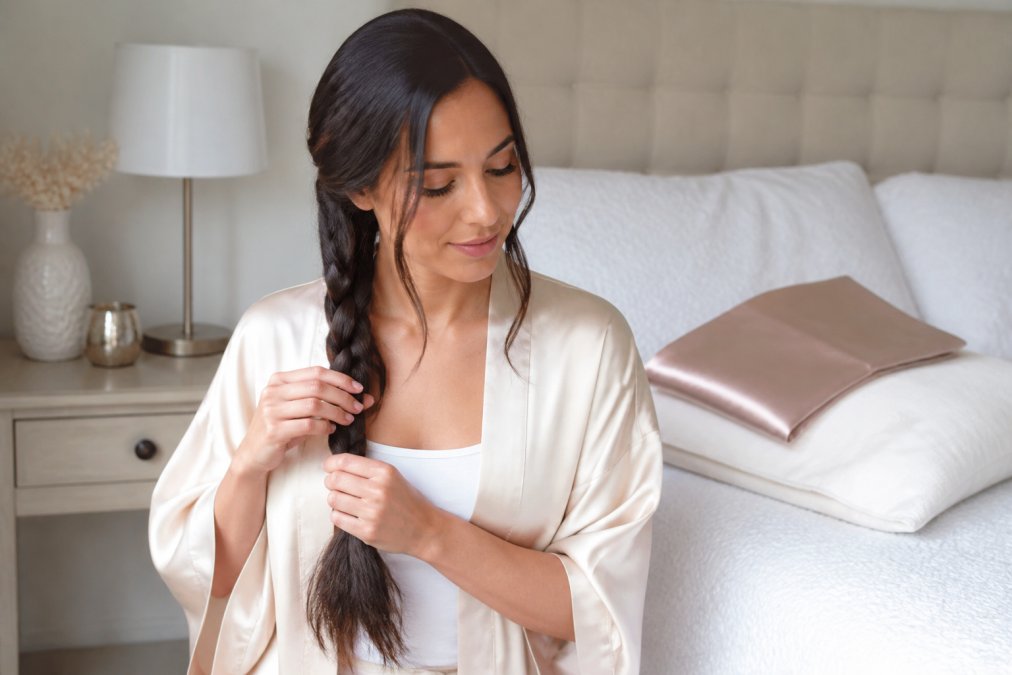
The non-negotiable habits:
- Braid or loosely ponytail the hair before bed. A single loose braid or low ponytail keeps extensions contained and prevents strands from wrapping around each other. Do not braid tightly.
- Switch to a silk or satin pillowcase. Silk and satin generate dramatically less friction than cotton. A silk bonnet or sleeping cap achieves the same result.
- Apply a small amount of leave-in conditioner or hair oil before braiding. This keeps strands smooth throughout the night.
- Never sleep with wet extensions. Wet hair is most vulnerable. Sleeping on wet extensions creates matting that can be nearly impossible to detangle without shedding.
The silk pillowcase recommendation is supported by hair care and friction research from the International Journal of Trichology, which documents how surface friction affects the hair cuticle during prolonged contact.
Heat, Environment, and Styling: Protecting Extensions All Day
Heat damage to extensions is permanent. Once the cuticle is scorched or protein bonds are broken, the damage is irreversible and tangling accelerates rapidly.
Always use a heat protectant spray before any heat styling tool touches the extension hair. Apply it to dry hair and allow it to set for 30 seconds before using the iron or dryer. Keep flat irons and curling wands below 350°F for human hair extensions. For blow drying, use medium heat and always direct airflow downward, from root to tip.
Humidity, Wind, and Friction: The Environmental Factors Most Guides Ignore
Humidity causes the hair shaft to swell as it absorbs moisture from the air. When the shaft swells unevenly, the cuticle lifts and extensions frizz and tangle. A light anti-humidity serum or smoothing oil applied in the morning creates a barrier that slows moisture absorption.
Wind physically wraps strands around each other. On windy days, wear the hair in a loose braid, low ponytail, or half-up style to prevent wind-driven tangling.
Friction from clothing and bags is the most overlooked source of daytime tangling. Bag straps, coat collars, and scarves create constant friction against mid-lengths and ends. Wear the hair up when carrying a shoulder-strap bag, or tuck the ends inside a coat collar.
| Environmental Factor | What Happens to Extensions | Prevention Method |
|---|---|---|
| High humidity | Cuticle lifts, frizz, tangling | Anti-humidity serum or smoothing oil |
| Wind | Strands wrap and knot | Low ponytail or loose braid |
| Clothing friction | Mid-length and end tangling | Wear hair up or tuck ends away |
| Heat styling | Permanent cuticle damage | Heat protectant, max 350°F |
| Dry indoor air | Moisture loss, static, tangling | Leave-in conditioner, humidifier |
Millionaire Beauty Brand Extensions offers in-house formulated hair care essentials that can help address these environmental stressors, with products designed to protect the cuticle from humidity and friction while maintaining natural movement and shine.
Preventing hair extension tangling requires a consistent routine built around the right tools, the right products, and an understanding of what your specific extension type actually needs. The Millionaire Beauty Brand Extensions collection of 100% human hair extensions is engineered for durability and natural movement, but even the finest human hair requires proper daily care to stay tangle-free. Explore the full range of extensions and in-house hair care essentials at Millionaire Beauty Brand Extensions, and get the polished, tangle-free finish your investment deserves.
Frequently Asked Questions
Q: Why do my hair extensions get tangled so easily?
A: Extensions tangle faster than natural hair because they no longer receive the scalp's natural oils, which keep strands lubricated and smooth. Friction from clothing, sleeping, and styling strips moisture further. Fixing the problem means replacing lost moisture with leave-in conditioners, brushing from ends to roots daily, and protecting extensions from friction overnight with a silk pillowcase or sleeping cap.
Q: How often should I wash my hair extensions to prevent buildup and knots?
A: For clip-in extensions, washing every 15 to 20 wears is enough, overwashing strips moisture and accelerates dryness. Permanent extensions like tape-ins or sew-ins should be washed every one to two weeks using a sulfate-free shampoo. Always detangle gently before washing, work shampoo downward from root to tip without rubbing, and finish with a moisturizing conditioner. Skipping conditioner is one of the fastest ways to trigger matting and shedding between wash days.
Q: How do I keep synthetic hair extensions from tangling compared to human hair?
A: Synthetic fibers cannot be moisturized the same way human hair can because they do not absorb oil-based products. For synthetic extensions, use a detangling spray formulated for synthetic hair, never apply heat above the manufacturer's recommended temperature, and store them on a wig stand or in a silk bag. Human hair extensions respond well to oil treatments, leave-in conditioners, and heat styling with a protectant. The care regimen is fundamentally different, and using human hair products on synthetic fibers often makes tangling worse.
Q: Why are my hair extensions matting at the nape of my neck?
A: The nape is a high-friction zone: collar rubbing, ponytail elastics, and natural hair movement all concentrate stress there. To reduce nape matting, brush that section separately twice a day, avoid tight ponytails that pull the weft, and apply a small amount of lightweight oil to that area after washing. Sleeping in a loose braid also significantly reduces overnight friction at the nape.
This article was written using GrandRanker